Biggest news: 2032
Every Olympic event has spent this year under the same question: what does the 2032 slate look like?
The Events Committee was pushed to hand Council a menu of options. It sent one recommendation instead. The Nacra 17 is part of it.
Council makes the decision, and it has not voted yet. But a single technical recommendation from the committee that studied the slate is the strongest position a class can take into that room.
The recommendation comes with required changes for the Nacra 17, and the class welcomes it.
First, a format built for broadcast. SailGP races 13 boats and draws roughly ten times the audience of anything else in sailing. World Sailing wants the Olympic Nacra 17 racing to borrow from that model: shorter, sharper, built around a final that a non-sailor can follow.
Second, fleet-managed daggerboards. The class will find a method to ensure teams race with supplied daggerboards suitable for elite racing, so the focus remains on sailing and racing instead of equipment.
How the daggerboard pool works
The question raised most often about the Nacra 17 at Council was cost. A team that finds a fast set of boards has an edge, and finding one means buying, testing and discarding sets the rest of the world cannot afford.
SailGP solved this years ago. The league owns the foils and the teams race them.
The proposal for the Nacra 17 follows that model. A central pool of about 20 sets of boards for an 18-boat Olympic fleet, managed by the class or the event host. The same pool travels to Palma, Hyères, Kiel, the Europeans, the Worlds, the test event and the Games. Sets rotate between teams by the day or by the race.
Over time the sailors vet the pool, statistically and by feedback, until what is left is a matched set. Teams aren’t seeking to own great boards. Instead they are ensuring the entire pool of boards are suitable for elite racing.
The money that went into the foil hunt get’s saved from the campaign budget. The nations who could never afford the hunt can be secure in the knowledge their competitors don’t have an equipment adavantage.
Biggest small number: three
© Sailing Energy / 49er and Nacra Class
Seven major regattas made up season one of the LA28 cycle, from the 2025 Worlds in Cagliari to San Pedro in August. Three crews won all seven.
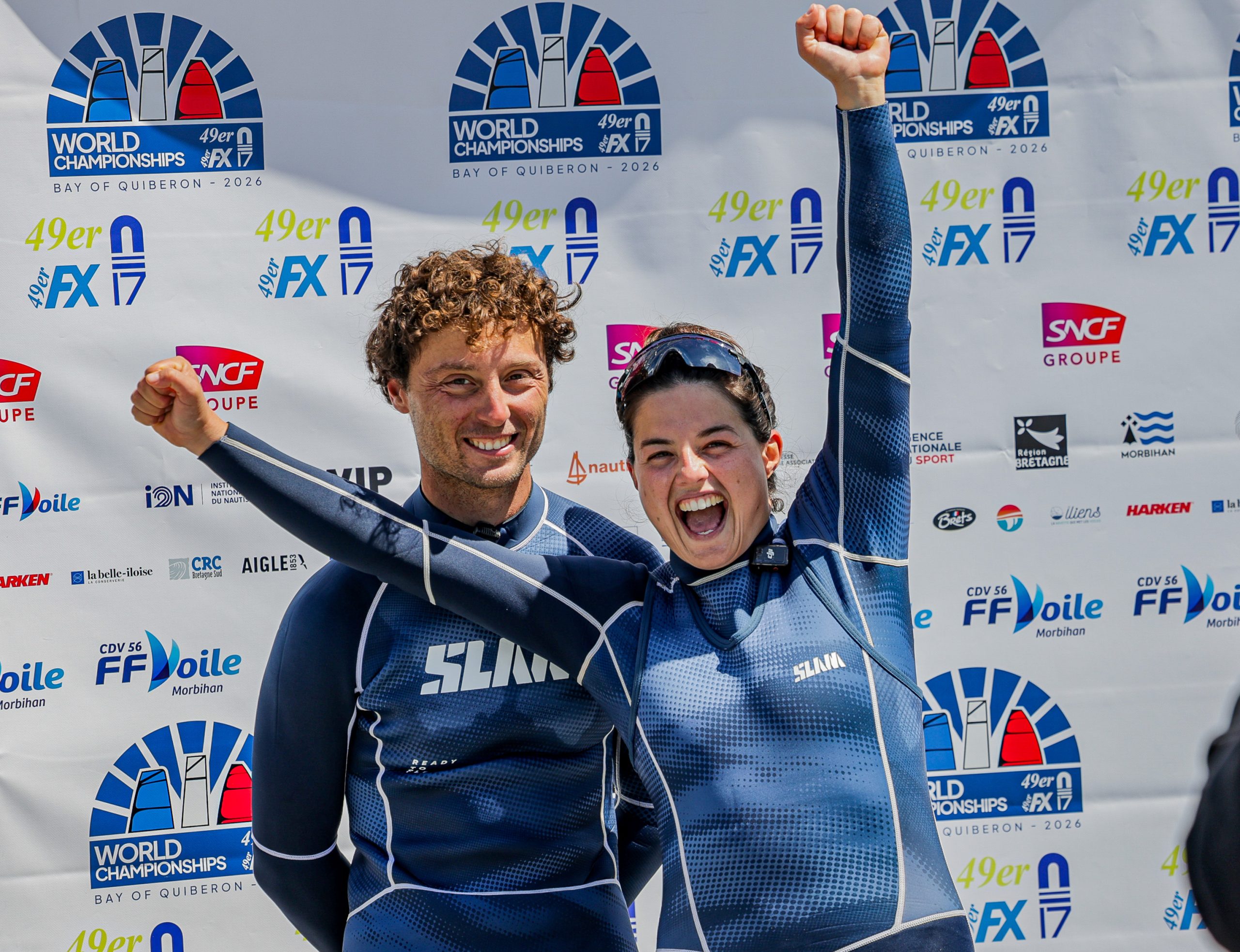
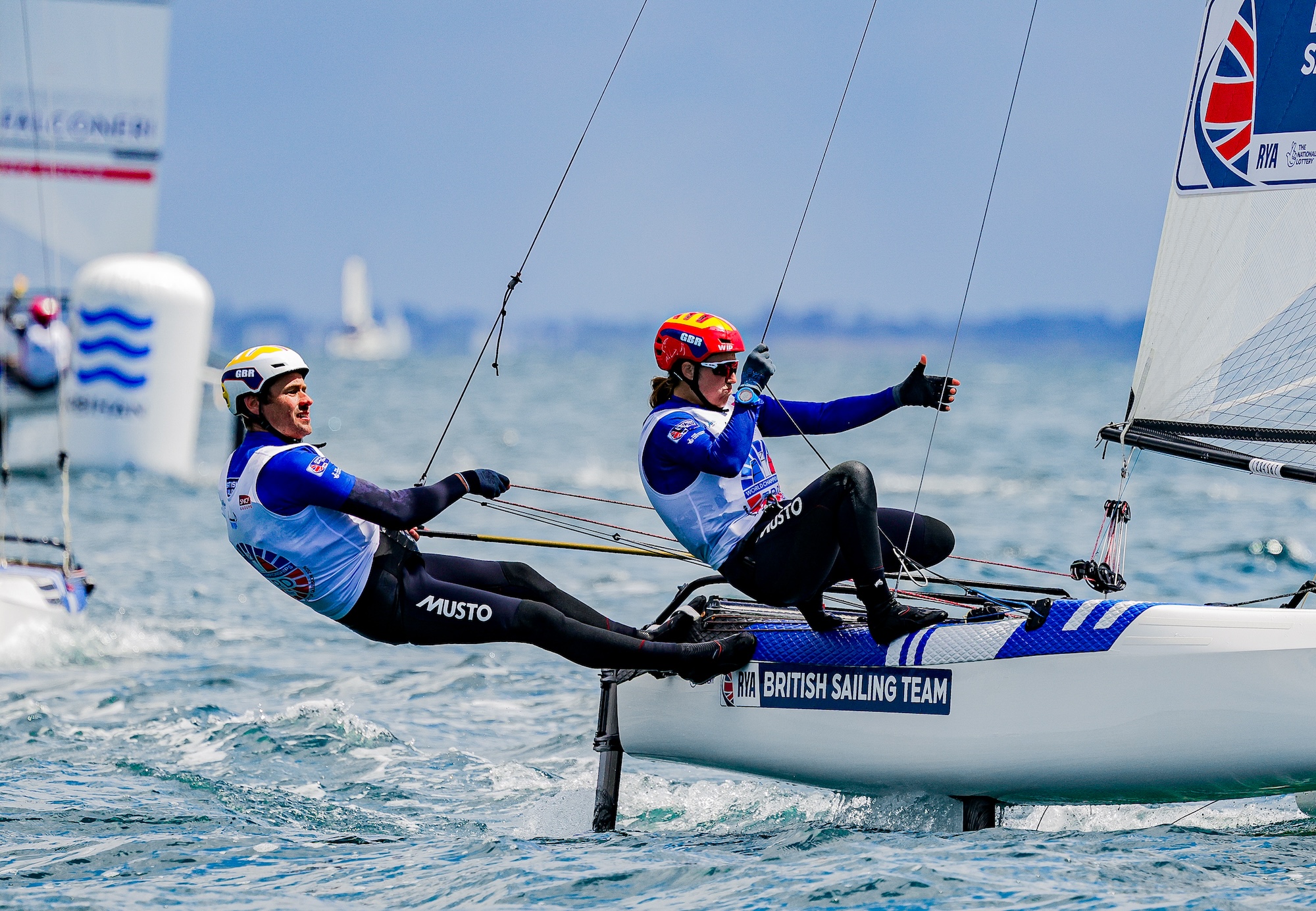
John Gimson and Anna Burnet (GBR 21) won Cagliari and Kiel Week. Gianluigi Ugolini and Maria Giubilei (ITA 98) won Hyères and the World Championship in Quiberon. Emil Järudd and Hanna Jonsson (SWE 14) won Palma, the Open Europeans in Eckernförde and San Pedro.
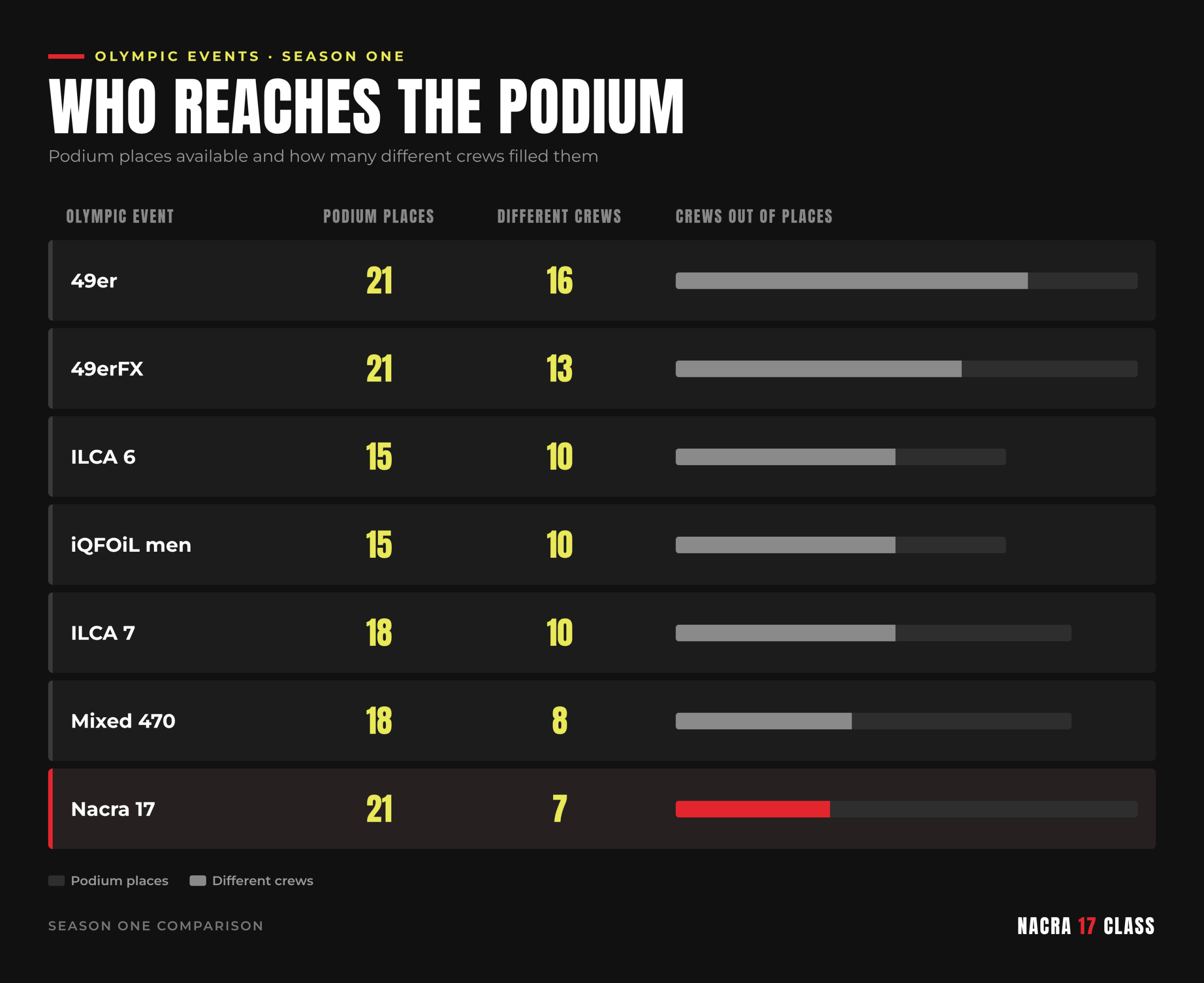
Seven different crews shared the 21 podium places. That is the tightest group at the top of any event on the Olympic programme this season. The 49er, from the same seven regattas, put sixteen different teams on the podium.
The 49er is wide open. The Nacra 17 has an elite.
Best record in Olympic sailing
© Sailing Energy / 49er and Nacra Class
Gimson and Burnet entered seven regattas and finished in the top ten at all seven. They reached the podium at six.
Nobody in the 49er, the 49erFX or the Nacra 17 came close to that record this season. They went into the summer as world number one, with four Nacra 17 world titles, a silver from Tokyo and a fourth from Paris behind them.
The one regatta they did not podium was Hyères. They finished in the top ten there too.
On the new Nacra 17 stats page they sit third for share of the fleet beaten at the Europeans, 84.3 percent. Their season page has the rest.
Best line of the season
Gianluigi Ugolini, speaking in Hyères in April, a month before he won the world title:
“The level of the fleet has risen a lot. I think now you need to be happy with top five results.”
That is what a hard fleet sounds like from inside it.
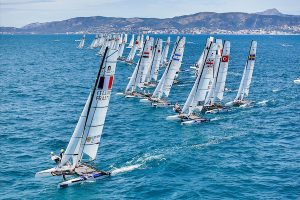
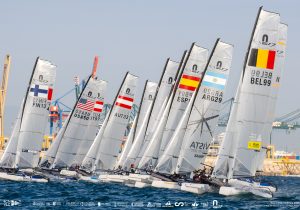
The skill has changed shape, too. At the Quiberon Worlds the fleet switched between low-riding, one hull out and two hulls out as the breeze moved. Switching modes cleanly now decides more races than raw foiling does. In 2019, analysis at Kiel Week found three national squads using three different hoist techniques. Today the fleet has converged on a method. That is what a maturing class looks like.
The ten
Count top-ten finishes and exactly eight crews made four or more. The ninth-best made three. That cliff is sharp.
Count trophies and two more crews belong in the conversation, because they picked their regattas.
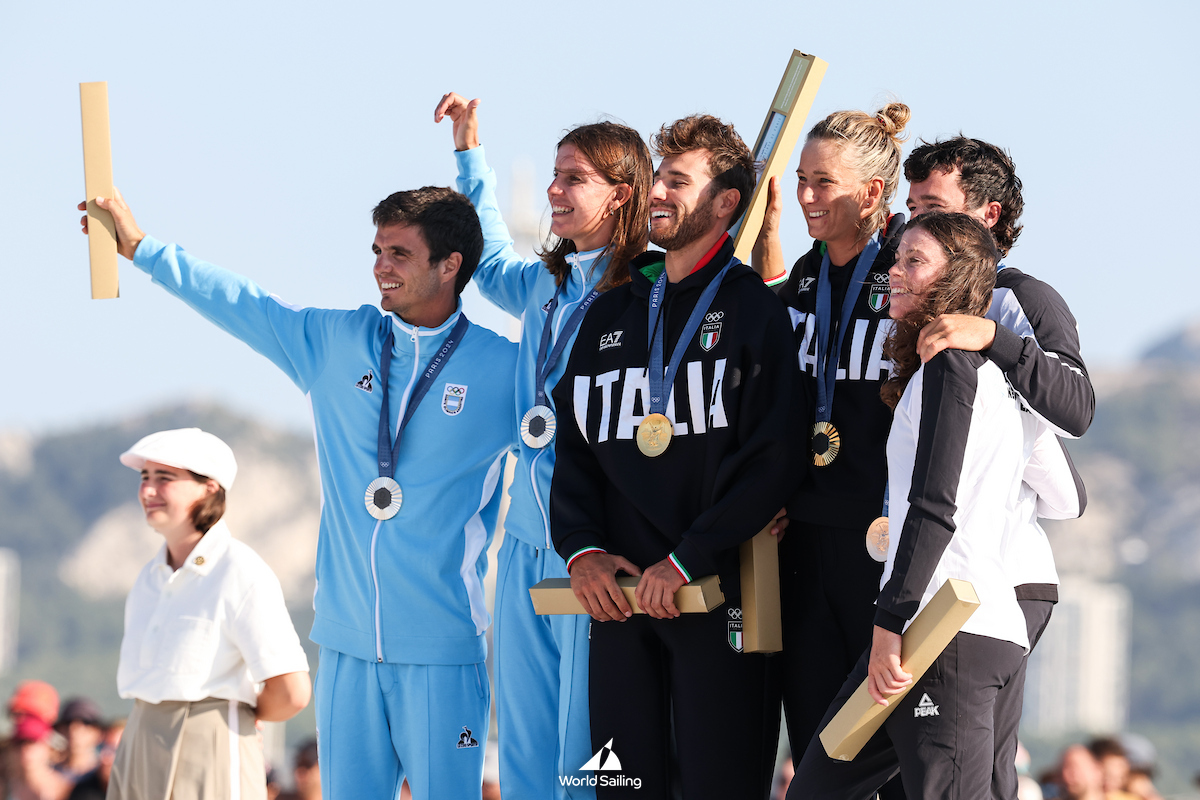
Ugolini and Giubilei entered three, won two and were second at the third. Ruggero Tita and Caterina Banti, double Olympic champions, announced their reunion on 18 March after about twenty months out. They led Hyères after day one and finished fourth.
So the contender group for Los Angeles is ten:
- John Gimson / Anna Burnet (GBR 21)
- Emil Järudd / Hanna Jonsson (SWE 14)
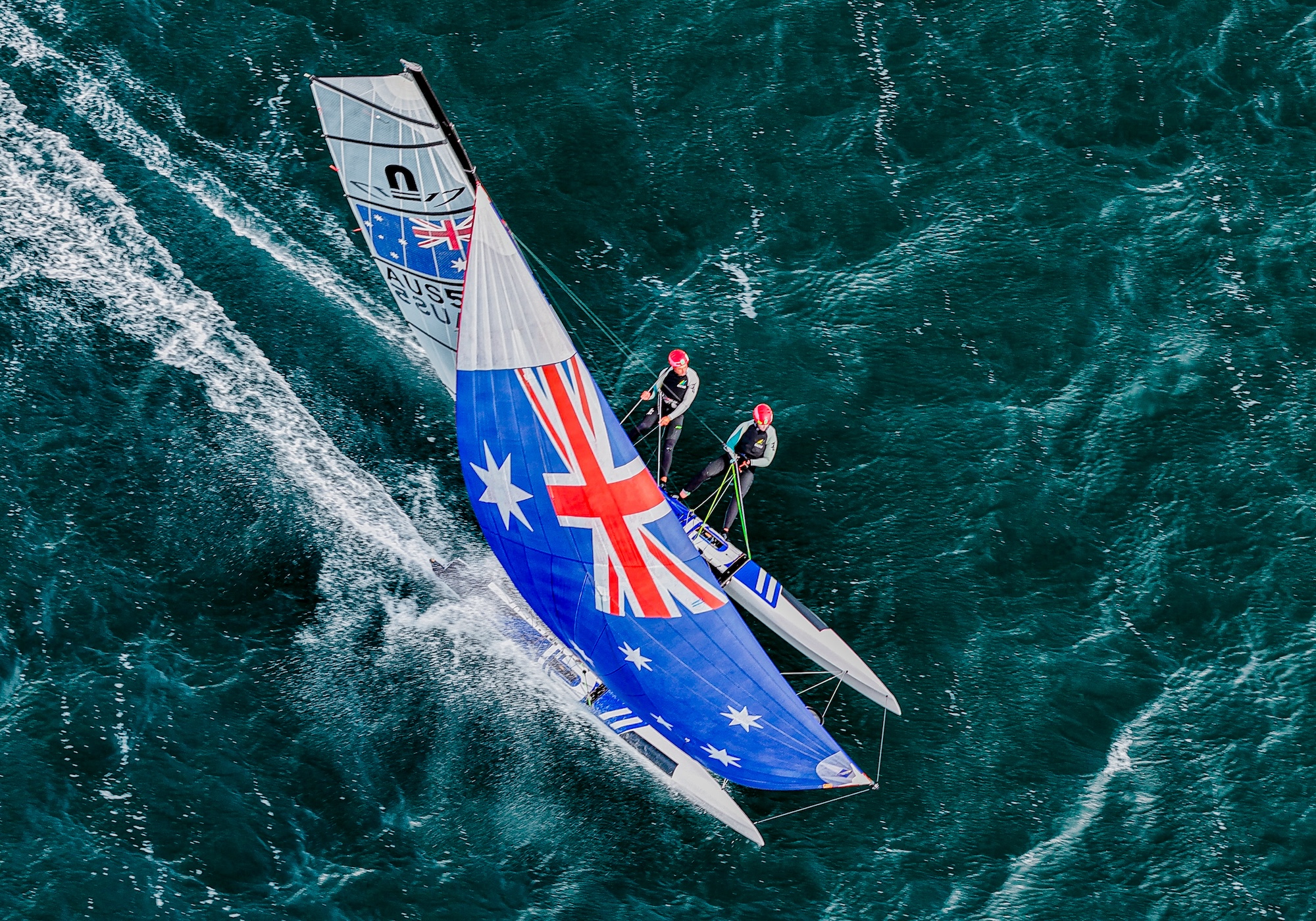
- Brin Liddell / Rhiannan Brown (AUS 5)
- Willemijn Offerman / Scipio Houtman (NED 22)
- Mourniac / Retornaz (FRA)
- Majdalani / Bosco (ARG)
- Sinem Kurtbay / Alican Kaynar (TUR)
- Farese / Zöchling (AUT)
- Gianluigi Ugolini / Maria Giubilei (ITA 98)
- Ruggero Tita / Caterina Banti (ITA)
Ten crews, and every one of them can see a medal.
© Sailing Energy / 49er and Nacra Class
Best crew without a trophy
Brin Liddell and Rhiannan Brown (AUS 5) finished in the top ten at all seven regattas. They never once reached the podium in the senior fleet.
Childhood friends from Lake Macquarie. Nacra 15 in 2019, Nacra 17 from 2020, Olympians in Paris. World number three.
They were fourth at the Cagliari Worlds and fourth at the Europeans. Consistency at that level usually turns into silverware eventually. Season two starts in Palma.
The stats page shows how they do it. At the Europeans they ranked fourth for top speed, fourth for starts and fifth for share of the fleet beaten. Their season page has it race by race.
Biggest selection problem
Italy has had three different crews win Nacra 17 world titles since 2018. It gets one place in Los Angeles.
Tita and Banti hold the last two Olympic golds. Ugolini and Giubilei hold the current world title. Both crews sail for the same federation, and both have one foot in the America’s Cup.
No other nation in Olympic sailing has a problem like it.
Best bridge: Naples
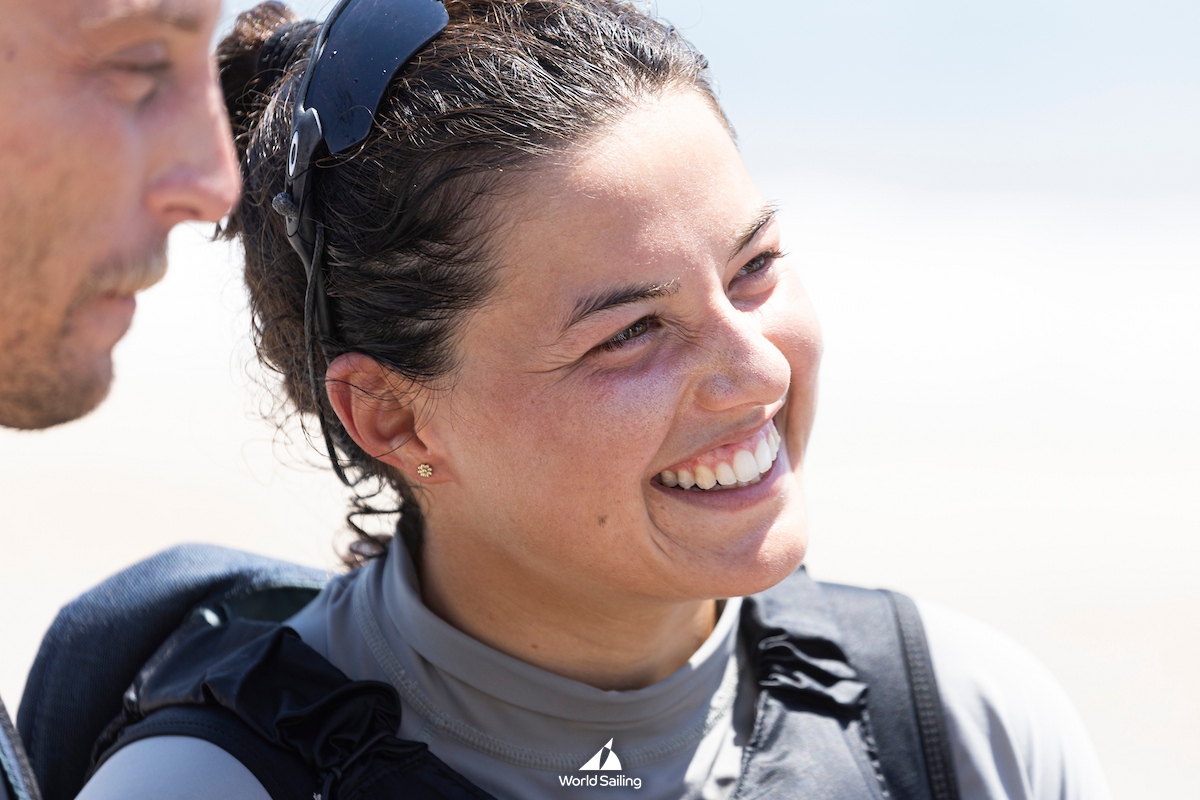
We wrote two weeks ago that Naples was won by 49er and Nacra 17 sailors. Luna Rossa won the second Preliminary Regatta of the 38th America’s Cup with Ugolini and Giubilei trimming, four months after they won the Nacra 17 Worlds.
Freddie Carr, on The Foil Debrief, singled out Giubilei’s traveller work as the best trimming in the fleet. Erica Dawson, Nacra 17 bronze medallist in Marseille, won the Women & Youth division with Emirates Team New Zealand. Eight of the 36 sailors in Naples had raced the Nacra 17.
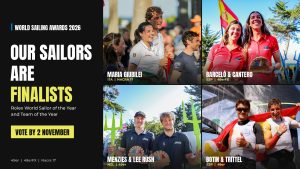
The Cup teams hire from this class because a decade of racing a foiling catamaran at the front of an Olympic fleet is the best training for an AC40 that exists. That is also part of the case for 2032. Giubilei is now nominated for Rolex Sailor of the Year!
Best year for the start line
2026 has been a big year for technology in Olympic sailing, and most of it happened in the first ten seconds of each race.
The 49er adopted Vakaros electronic starting early in the season. Each boat carries a unit that knows its own position against the line to within a few centimetres. At the gun, the race committee knows exactly who was over, by how much, in real time.
The mechanism matters. A general recall happens when a race officer can see that a group of boats was over but cannot be sure which ones. Electronic starting removes the uncertainty. Every boat that is over gets identified individually, so there is no reason to recall the whole fleet.
The 49er went through the season with almost no general recalls. Race days ran on time. Sailors stopped gambling on the crowd.
World Sailing has since asked every Olympic class to adopt electronic starting.
The Nacra 17 tested Sailtech’s system at the Europeans in Eckernförde in July. It used Sailteck again at the Valencia Cup. A catamaran approaching the line at foiling speeds is exactly the boat that benefits most from a start line nobody has to guess about.
Every crew’s 2026 numbers are already on the Nacra 17 stats page.
Best ending
The Nacra 17 has ten crews who can win in Los Angeles, a world champion trimming an America’s Cup winner, an electronic start line and a tracker anyone can watch.
And a recommendation on the table to keep doing it in 2032.
Council has the last word.
The numbers: season one
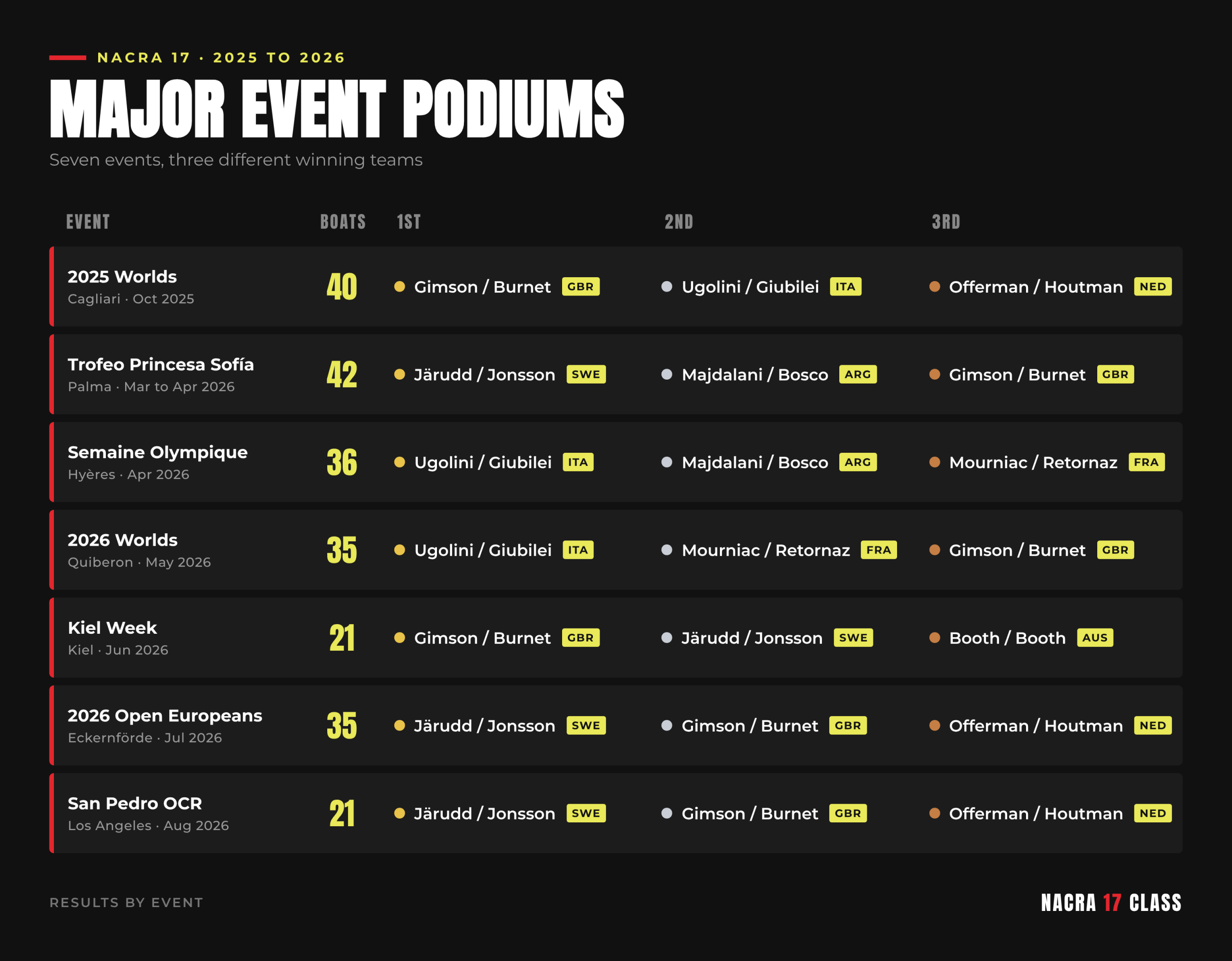
Three winners. Seven podium crews from seven nations. Twenty-two different crews in the top ten.
Sources and related coverage
- Nacra 17 season stats and 49er and 49erFX season stats
- Results: official Manage2Sail results for the 2025 and 2026 World Championships, the 2026 Open Europeans and Kiel Week; official event results for Palma, Hyères and San Pedro
- NACRA Cup Valencia event page and live tracker
- Naples Was Won by 49er and Nacra 17 Sailors
- 2026 Nacra 17 World Championship and Three first-time World Champions in the Olympic cat and skiffs
- Gimson and Burnet snag 2025 Worlds from the Italians
- 2026 European Championship Nacra 17 replay (tracker v0.5.2)
- Ugolini quote: Hyères, April 2026 (Giornale della Vela)